
Biomethane strategy presented to government
17 March 2026
Biomethane could meet half of New Zealand’s natural gas demand by 2050, a new report from GasNZ says.
Produced by breaking down organic waste and other organic materials, biomethane can be a core part of our renewable energy supply by 2035, GasNZ’s chief executive Jeffrey Clarke says.
The Biomethane Strategy and Action Plan presented to the government at the request of the Minister of Energy and the Minister for the Environment, sets out a viable pathway for getting there.
Clarke says biomethane offers New Zealand a practical way to strengthen energy security and independence while also offering a huge environmental opportunity, supporting a truly circular economy.
“It gets value from our waste, reduces our greenhouse gas emissions and helps New Zealand’s energy shortages at the same time.”
Biomethane is a direct, low-emissions substitute for natural gas, he says.
“It is made out of materials we no longer need, and uses the infrastructure we already have.
“That makes it one of the most sensible, practical ways to grow renewable energy in New Zealand.”
Biomethane is especially valuable for businesses which depend on the very high, fast heat of natural gas, and can’t easily move to a different energy supply, Clarke says.
Because it is mainly produced in the regions, it is also a boost to regional economies, he says.
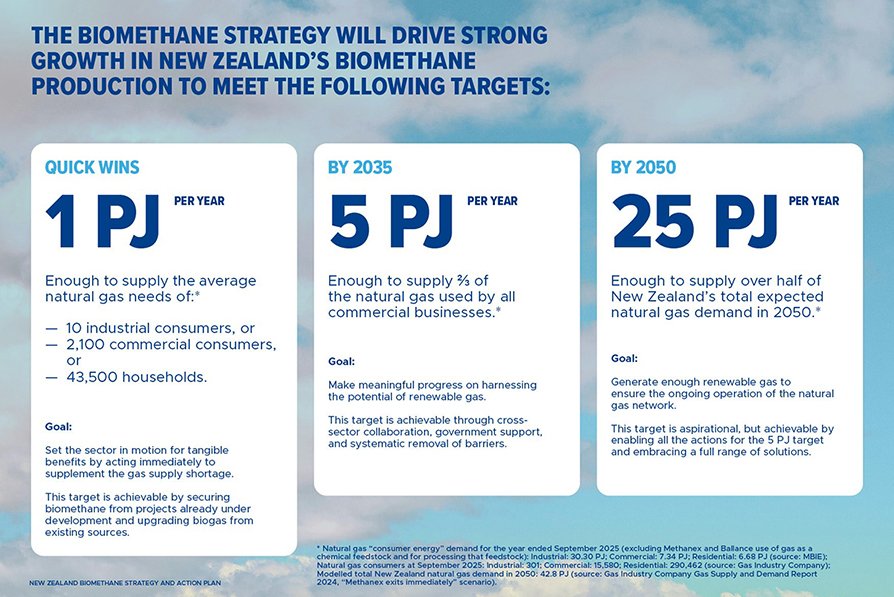
The strategy’s first target, producing one petajoule (PJ) of biomethane per year – the equivalent of one percent of current natural gas production – can be quickly achieved by securing biomethane from projects already under development and upgrading biogas from existing sources, Clarke says.
These include wastewater treatment plants and landfills.
“One PJ is enough renewable, low-emissions gas to supply 3,100 typical commercial consumers, 10 typical industrial users, or 43,500 households.
“That could readily scale up to the second target, five petajoules by 2035 – the equivalent of five percent of current natural gas production – which would be enough gas to supply two-thirds of the natural gas used today by typical commercial businesses.”
The third target, getting to 25 petajoules by 2050 – which would equal half of our expected natural gas needs at that time – will take systematic effort, and international experience shows we can do it, Clarke says.
Harvesting and using this biomethane gas would contribute significantly to the targets the government has committed to for reducing ‘biogenic’ methane emissions.
If not captured, the gas from decomposing organic matter is released into the atmosphere as a potent greenhouse gas.
While biomethane is already being produced and fed into the existing natural gas pipelines in small quantities, the strategy outlines what is needed to scale this up to make a significant difference to New Zealand’s renewable energy supply.
“New Zealand is way behind other countries in producing biomethane,” Clarke says.
Europe currently produces over 170 PJ of biomethane annually compared with New Zealand’s 100 PJ of natural gas, he says.
Denmark has replaced 40 to 45 percent of its natural gas use with biomethane sourced largely from animal waste with a goal of reaching 100 percent by 2035.
Based on what has worked around the world to accelerate biomethane, GasNZ’s action plan details the policies and actions needed now to produce five petajoules of biomethane by 2035 and 25 petajoules by 2050.
“Biomethane provides a sustainable, low-carbon alternative to declining natural gas reserves as we transition away from fossil fuels,” Clarke says.
Link to Biomethane Strategy and Action Plan: Summary Document
Link to Biomethane Strategy and Action Plan: Evidence Base, Framework and Analysis
Link to Sense Partners economic analysis: Systemwide effects of biomethane production in New Zealand